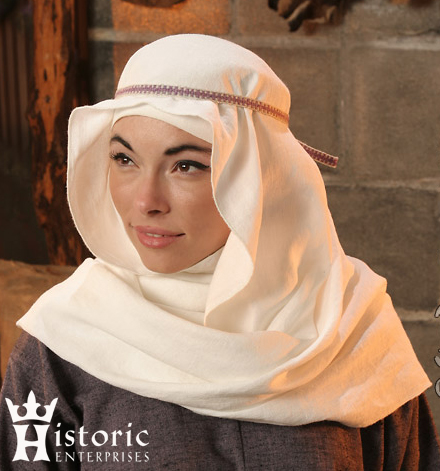
From Gwen..."I am indebted to the kind folks at Regia Anglorum, UK for their help and information on women's head coverings for this period as well as 'Dress in Anglo Saxon England' by Gayle Owen-Crocker."
Women covered their heads in tenth and eleventh century England as it was considered indecent for a woman to show her hair. The archaeological record offers little in the way of information for women's headcoverings in this period, so modern interpretations are of necessity based on illuminations and extrapolations from written sources. The most obvious head covering seen in visual sources was the wimple (O.E. heafod-gewaede, wimpel, wrigels), a length of fabric arranged around the head and shoulders and secured with pins (O.E. feax-preon, thrawing-spinel ), fillets (O.E. baende, wraed) or, if the woman was married, a length of band (O.E. binde). Some wealthier women also seem to have worn a hood (O.E. cuffie, cuffia, hod, hufe ) or triangular head scarf (O.E. feax-clath ) knotted at the nape of the neck, over or under their wimple. There seems to have been a nearly infinite number of ways to wear the headrail based on personal preference, local styles and customs.
Our Anglo-Saxon headrail set is made of fine ivory linen, hand woven wool braid in natural dye colours and hand made pins.
Set includes:
White linen ‘feax-clath’ (triangular headscarf) 36" x 26" (all sizes approx.)
30" woven wool headband/fillet
28" x 80" white linen wimpel (veil)
2 handmade pins
Please note: Colours for this range have been carefully matched to natural dye samples. Please refer to the Fabric Colours, Weaves and Information section.
This product has been developed in consultation with the Authenticity officers for Regia Anglorum in the US and UK, and the Vikes UK and NA. Although it is policy for both groups to avoid giving blanket endorsements to vendors, this set conforms to current Regia Anglorum and Vikings kit standards.
This product was added to our catalog on Friday 17 October, 2008.